Sunday, February 23, 2014

Steak and Guinness Pie


Yes, it’s true, I’ve done my fair share of hanging out in pubs in my time, and there’s nothing quite like a good pub to take the edge off the day and provide a comfy, cozy locale to kick back with ya mates, mate.  A good pub, in my humble opinion, should have good beer (that goes without saying).  It should have a good environment--not too bright, not too loud--so one can converse in peace.  It should also have good pub faire, a.k.a. tucker, grub, vittles, or viands.  That is to say, it should have good food.  (Man does not live on beer alone)

Of all the various incarnations of pubs out there, the most friendly, the most inviting, the most welcoming sort has to be the Irish Pub.  Ubiquitous throughout the Emerald Isle, these dens of Gaelic Goodness can also be found worldwide in just about any sizable city worth its salt.  It was in one of these, in the fair city of Dublin, that I first tasted today’s delicious dish: Steak and Guinness pie. 

A variation of the steak and ale pie, this dish uses Guinness Stout as its signature ingredient, instead of a lighter ale, and the results are terrific.  The rich, black, malty stout produces an out-of-this-world flavor that makes this pie tops in the pub-grub department.


Steak and Guinness Pie

2 lbs Stew Meat (Cubed Chuck, Round or Similar Roast)
Olive Oil
1 Red Onion, Diced
3-5 Cloves Garlic, Minced
3 Carrots, Chopped
3 Celery Stalks, Chopped
12-15 Medium-Sized White Mushrooms, Halved
2 Teaspoons Dried Thyme
24 Oz Guinness Stout
24 Oz Beef Stock (more as necessary to top up)
2 Tablespoons Flour
2 Tablespoons Tomato Paste
1 Tablespoon Worcestershire Sauce
Salt and Fresh-Ground Black Pepper, to Taste
1 Cup Grated Cheddar
1 Package (2 Sheets) Ready-Made Puff Pastry, Thawed
1 Egg, Yolk and White Whisked Together

Thaw your puff pastry sheets according to directions on the box.

Cut your steak into 1-inch cubes.


Brown the beef cubes in the olive oil.  


Remove and reserve. 

Sauté the diced onions until they are translucent and just beginning to brown, about 8-10 minutes.  


After about 5 minutes, add the garlic. 

Add the celery and carrots and stir, then continue cooking for a few minutes. 


Add the Mushrooms.  Cook a few minutes more. 


Return the beef to the pan.  


Add the dried thyme, tomato paste, flour, Worcestershire sauce. Add salt and pepper to taste. 

Add the Guinness Stout.  


Have a bottle or two for yourself as well.  This will of course aid the cooking process.

Add the beef stock until everything is just covered.  Bring to a boil, then reduce to a simmer and put a lid on it.  


Allow to simmer for 1.5 to 2 hours, stirring occasionally.   Keep an eye out that the liquid does not all boil away.  This shouldn’t happen if you’ve got things set on a low simmer, but it if does, add a bit more beef stock. 

After the 1.5 to 2 hours, check a piece of beef and make sure it is tender.  Continue to simmer if it is not, but it should be ready to go by this time.  If the concoction is still pretty liquidy, mix a little cornstarch with a few ounces of hot water, then add this to the stew and stir.  This will thicken it up nicely. 


Add the cheddar cheese and stir it in until it melts. 


Next, ladle the stew into ramekins or other small, oven-proof bowls.  


Set aside.

Now, back to that puff pastry.  Hopefully, it is nicely thawed by now.  Unroll one of the sheets on a well-floured surface.  


Divide it with a knife or pizza cutter into two relatively even pieces that will be able to cover your ramekins.  


Repeat with the other sheet and then blanket a piece over each ramekin of stew filling.  If you want, you can trim the puff pastry so that it just covers the ramekin, but I just let the excess hang down the sides.  That way there will be more delicious golden brown pastry top for eating. 

Using a Lamé or a sharp knife, cut some cris-cross slits into the puff pastry to allow steam to escape.  


Next, whisk the egg yolk and white together and then brush this mixture on the pastry tops.  


Heat your oven to 400F and bake these babies for 40-45 minutes, or until the tops are golden brown and beautiful.  


Serve and enjoy, but be careful, the filling will be piping hot.  


Hopefully, you’ve still got some Guinness on hand to cool things off. 


Until next time,

Sláinte!

Chris


Saturday, February 1, 2014

New York Reuben Sandwich


Ingredients

32 oz Corned Beef
4 Slices Rye Bread
8 oz Sauerkraut 
1/2 Cup Russian Dressing
4 Slices Swiss Cheese
4 Tablespoons Butter


Time to make one of my favorite deli sandwiches, the indefatigable Reuben Sandwich.  Last month we made homemade rye bread and Russian dressing (well, last month in blog time, in reality, I made them the same day as we're making the sandwiches, but hey, I'm a busy guy, and blogging takes time).  So this month we're gonna put them to good use and make this simple yet tasty sandwich.  

Reuben Sandwich


First, sprinkle the corned beef with a bit of water, then wrap in foil and place in a 300F oven for about 15 minutes.  


This will steam the beef and release more of its salty, tangy flavor.  Allow about a half to a full pound of beef for each sandwich.  Go with the half if you're feeling light, the full pound (or more) if you want an authentic NY deli bruiser.  Don't go less than a half pound, as it just wouldn't be a Reuben if it didn't have that thick layer of meat.  

While the meat is steaming, slice your rye bread into fairly thick slices.  


Then brush each slice with melted butter.  (these are the sides we'll be grilling)


Flip 'em, then spoon a liberal amount of the Russian dressing on the unbuttered side.  

Remove the corned beef from the oven and unfoil it.  Layer your preferred amount of the beef on top of one of the dressed up bread slices.  


On top of this, layer a liberal amount of sauerkraut.  Try to get a good, fresh variety of kraut, and not the canned sort.  

Next, layer a few slices of the Swiss cheese on.

Admire this massive stack of deli-goodness:

Next, flip one of the other slices of bread, dressing side down, on top of the whole assembly, forming the sandwich.

Place the sandwich on a hot griddle or in a skillet if that's what you prefer, and grill for a few minutes a side until the sandwich browns a bit and the cheese begins to melt.  Sometimes, placing something heavy on the sandwiches like a bacon weight will help them grill up better.  

When the sandwich is finished, slice it in two and and admire that baby's beefy cross-section:

Finally, serve it with some chips, a pickle or two, and perhaps some extra Russian dressing.  Enjoy!


Until next time, 

Fogetaboutit!

Chris


Sunday, January 26, 2014

Russian Dressing


Ah, Russian dressing.  Of all the salad dressings and sauces, there is perhaps more controversy surrounding this condiment than any other.  Where did it come from?  (News flash: It wasn’t Russia) What ingredients should be used in making it?  What color should it be?

Sadly, I don’t have all these answers.  The origins of Russian dressing are lost in the mists of time.  Sure, you’ll find stories on the internets and in foodie books, but they all seem to disagree with each other, so instead of repeating any of them here, I’ll just say that it most likely appeared sometime around the early Twentieth Century—A time I like to call the Golden Age of salad dressings.  Prior to this time we pretty much had oil and vinegar to dress a salad.  But suddenly, new and interesting dressings started popping up around the globe with great regularity.  Italian dressing was born, then French, Caesar, Green Goddess, Thousand Island.  All of these and many more popped up in the first few decades of the Twentieth.  


By the 50s, it was a regular smorgasbord of dressings available.  It truly was, ahem, the salad days, and a great time to be a dressing aficionado.  (I am, in fact, a dressing aficionado.  I keep over a dozen on hand at any given time.  But hey, variety is the spice of life, right?)

Speaking of Thousand Island, this dressing has a bit of a murky history as well, perhaps because it is muddled up with Russian dressing’s history.  


One was most likely an offshoot of the other, but no one is sure which came first.  (Though some will argue that they know)  The two are used interchangeably in many recipes (including Reuben Sandwiches), and they are quite similar in taste and appearance.

Now, if your only familiarity with Russian dressing is Aisle Seven of your local Piggly Wiggly, well then, you might say, “Chris, Russian and Thousand Island are different.  Look, here’s a picture!”


And to this I would say, yes, store-bought Russian dressing is somewhat different from T.I.  It has a deep red color as opposed to beige, and it tastes strongly of celery seed.  In fact, other than that celery seed flavor, it is quite close to Kraft’s Catalina French dressing.

But, I say to you--if you go to a real, honest Injun New York deli, this isn’t what you’re gonna get on your Ruben.  You’re gonna get something that looks like Thousand Island.  But, it’s gonna taste slightly different than the T.I. you’re used to.  And that’s because it’s not T.I., it’s Russian.  Confused?  Me too.  There are more Russian dressing recipes out there than you can shake a hammer and sickle at, and they’re all different.  But hey, I wanna make some Russian Dressing so I can make me a Reuben.  So, what to do?

Well, I decided that if anyone is an authority on the matter, it should be those good folks who run the aforementioned N.Y. Delis.  I remember the taste of their Russian, so I decided that was what I would shoot for when I mixed me up a batch. 

I started with about six different recipes, and tried them all.  All were interesting, and one was even a little bit weird.  It had beets in it, which I thought was cool (beets are so Russian-y, after all), but this one came out all pink, and it tasted a bit beet-y, so it wasn’t really like any R.D. I’d ever tasted.  I liked it, but it weren’t what I was looking for.

I finally came up with combining some of the recipes, taking what was common to all of them (like mayo, relish and horseradish) and then tweaking it a bit here and there.  In fact, speaking of the horseradish, I think this is the one ingredient that sets Russian apart from T.I.  Most Russians have horseradish, most T.I.s do not. 

But, enough with the histories and formalities.  Let’s go make us some dressing.  Some Russian dressing.  But unlike a Russian racehorse, we’ll take our time doing it. 


NY Deli-Style Russian Dressing

1 Cup Mayonnaise
1/3 Cup Heinz Chili Sauce
2 Tablespoons Sour Cream
2 Tablespoons Minced Cornichons (or Dill Pickle Relish)
2 Tablespoons Minced Onion
1 Tablespoon Prepared Horseradish
1 Tablespoon Celery Seed
1 Teaspoon Worcestershire Sauce
1/2 Teaspoon Lemon Juice
1/2 Teaspoon Paprika
1/2 Teaspoon Kosher Salt

Combine all the ingredients together in a bowl and mix thoroughly by hand with a whisk.  


Refrigerate for a couple hours to let the flavors meld.  That’s pretty much it.  Wow, I guess we didn’t need to take our time after all.  This really is the dressing to make if you’re in a rush. 

A few notes.  Use real mayonnaise and not Miracle Whip or such…they are not the same.  Make sure to use Heinz Chili Sauce.  


If you can’t find it for some reason, use ketchup rather than another brand of chili sauce.  The thing you’re going for with this condiment is a spicy tomato-y flavor, and that’s just what Heinz has, a spicier than ketchup ketchup flavor, with no actual chile heat.  Other sauces might have that heat, and while that might be nice for us chili-heads, it wouldn’t be apropos in our Russian Dressing. 

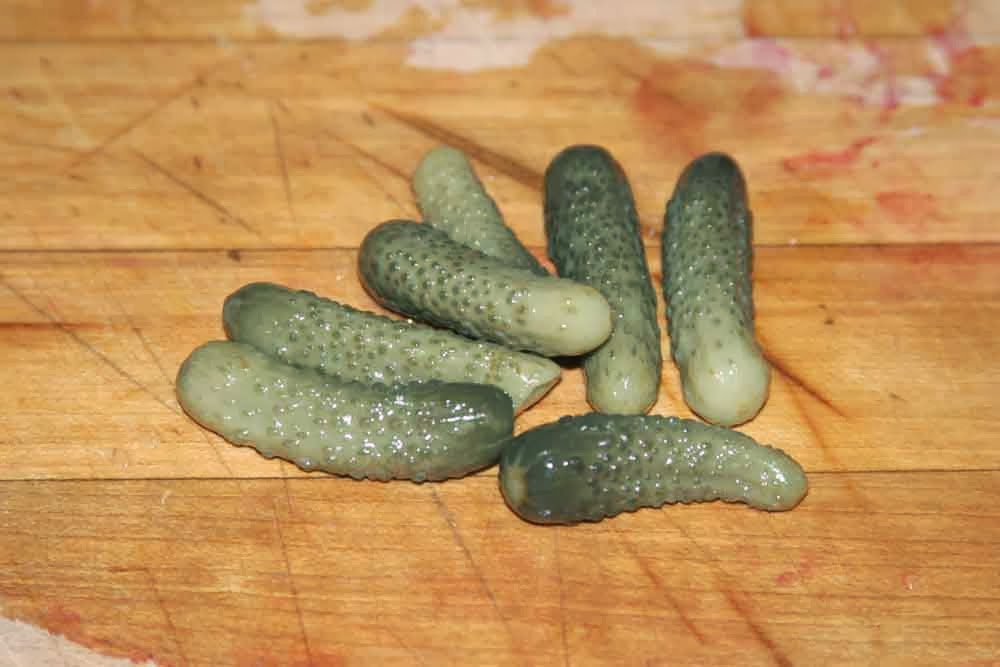
Also, try to find good cornichons for the recipe.  Maille brand from France are quite nice.  


Cornichons have a slightly different flavor than their more common cousin pickles, 


and I think they work much better in this dressing recipe than pickle relish does, which to me tends to be reminiscent of ball park hot dogs.  Finally, make sure you’re using celery seed, and not celery salt, which would make the dressing too salty.

That's about it, comrads!  


 Russian Dressing, chilled and ready to invade your taste buds!


Until next time,

Dasvidaniya!


Chris

Sunday, January 19, 2014

Sandwich Rye Bread


This month here at the Eat’n Man, we’re gonna work ourselves up to building the perfect Reuben Sandwich.  And were gonna do that by making all of the major components ourselves.  Well, okay, we’re not gonna corn our own beef, but we’re gonna do what good delicatessens do and make our own Russian Dressing and our own rye bread. 

I have to admit (full disclosure here) that growing up I was never a fan of rye bread.  But of course, growing up in Texas, I was in a delicatessen-starved region, thus I don’t believe I ever had an example of ‘good’ rye bread to try.  In fact, the first rye bread I ever tasted was on a sandwich I was served in a 1970s-era airport lounge here in Texas.  So, not to impugn 1970s-era airport lounges, but I can’t imagine they were bastions of gourmet goodness.  In fact, they probably rate just above school cafeteria cuisine. 

But, once I grew up and traveled to New York City and had me a Reuben Sandwich on some properly-made, properly-baked, just plain proper rye bread, I was hooked.  The bread was moist and slightly chewy, with a hint of an exotic taste that wasn’t overpowered by too much caraway.  And, that’s the bread that this recipe’ll yield ya.  It’s a slightly modified version of one from the nice folks over at King Arthur Flour.  Let’s get baking:

Sandwich Rye Bread: 

2 1/2 teaspoons instant yeast
3/4 cup water
1/4 cup vegetable oil
3/4 cup dill pickle juice
1 1/2 teaspoons salt
1 tablespoon sugar
1/2  teaspoon caraway seeds
1 1/2 teaspoons dill seeds
1 tablespoon yellow mustard seeds
3/4 cup instant mashed potato flakes
2 1/2 cups bread flour
1 1/3 cups pumpernickel flour

Dissolve the yeast in a couple ounces of the (lukewarm) water with a pinch of sugar. Allow to rest for 5-10 minutes.


Combine the dissolved yeast with the rest of the ingredients and mix until dough forms.  


Yes, that’s right.  There is instant mashed potato flakes in this.  And pickle juice.  Now, before you run me up on charges for having mashed potato flakes in the cupboard, I assure you I only use them in bread baking as a substitute for dedicated potato flour.  (they work fine for this).  I’m not using them to make my mashed potatoes.  You can read how to do that here.  Oh, and the pickle juice, it just adds a unique and exotic flavor that is right at home in this loaf. 

Knead the dough for a few minutes until it gets slightly stiff.  Probably about five minutes.

Place dough into a greased bowl, cover, and let the dough rise about one to one and a half hours.


Punch down the dough, then shape it into a log. Place the log in a lightly greased rectangular loaf pan. Press it to the edges of the pan, then flatten the top.


Cover the pan with greased plastic wrap and let the loaf to rise until it has risen about 1" to 1 1/2" over the edge of the pan, about 1 to 1 1/2 hours.


Preheat the oven to 350°F.

Using a lame (as pictured here) or a sharp knife cut slits in the top of the loaf about 1 to 1 1/2 inches apart. 


Bake for 20 minutes. Cover lightly with foil and bake for an additional 20 minutes. When done the bread will have turned golden brown and delightful.


Allow it to cool completely on a rack before slicing.


Until Next Time,

Hope you get a rise out of this one, 

Chris