Saturday, June 21, 2014

Chicken Normandy


When most of us think of Normandy, it’s the D-Day invasions that come to mind, but there’s more to Normandy than that.  It’s a region with a rich history all its own, and a rich culinary tradition to go along with it.  Normandy is famous for many culinary delights, including various cheeses, seafood and lamb.  But today we will concern ourselves with perhaps Normandy’s most famous food item:  Apples, and of course the fine apple brandy that comes from them. 


Known as Calvados, the brandy is produced throughout the region, and is quite delicious.  Unlike traditional brandy made from grapes, Calvados is made from the distillations of fermented apple juice.  It is delicious as an apéritif or a digestif, and of course it is a great ingredient to cook with.

I’ve had the pleasure of visiting Normandy a few times, and it was there I discovered this delicious dish.  I loved it then, and I think you will now. 


Chicken Normandy

4 Boneless, Skinless Chicken Breasts
6 Strips Bacon
1/4 Cup Flour
1 Teaspoon each Salt and Pepper
1 Teaspoon Granulated Garlic
1 Teaspoon Onion Powder
1 Medium Onion, Diced
1/2 Cup Calvados
1 Cup Apple Juice or Cider
2-3 Tart Apples, Peeled, Cored and Cut into Slices
1/2 Cup Heavy Cream
4 Tablespoons Butter
1 Tablespoon Fresh Thyme, Chopped (or Teaspoon Dry Thyme)
Fresh Chives, Chopped, to Garnish

Fry the Bacon until crispy.  


Remove bacon, crumble and reserve. 

Make a blend of the salt, pepper, onion powder and granulated garlic.  


Season the chicken breasts with this, then dredge them in the flour.  Sauté them in the bacon grease for about four minutes a side, then place them in an oven proof dish and hold them in the oven at 375F until your sauce is ready.  (The breasts will continue to cook in the oven, so keep an eye on them if you take too long to make your sauce) 


Add the onions to the skillet and cook for a few minutes, until they begin to turn clear.  Add the Calvados and scrape pan with a spatula to break up browned bits.  Let Calvados reduce a bit, then add the apple juice or cider.  


Let this reduce by half, then gather up the apples you've sliced...


...and add them to the mix.  Let these cook for several minutes until they are tender, 


then add the cream... 


and simmer until the mixture is reduced by half.  Add butter and allow to melt through.  


Reduce heat and stir in the thyme.  


Stir to let the thyme’s flavor permeate. 

Remove the chicken from the oven and arrange on plates.  Ladle the sauce over the breasts, making sure to get several apple slices on each plate.  Serve immediately, garnishing with the chives and bacon.


Here we’ve served the dish with some simple roast potatoes.  

Until next time,

Bon Appetit!


Saturday, June 7, 2014

Straw and Hay Pasta


This is a delightful yet simple little Italian dish that is as pleasing to the eye as it is to the tongue.  The name comes from the fact that the two colored fettuccini noodles you use (green and yellow) resemble a mix of straw and hay.  Cute, huh?

Of course, this got me to wondering, (city boy that I am), which is supposed to be which?  And furthermore, what’s the difference between ‘hay’ and ‘straw?’  To the internet, Robin!


A little research reveals that there is a difference between hay and straw.  Hay, apparently, is the green one.  It refers to grasses cut down fresh and baled for animal feed.  Straw is the dried stalks of wheat or other cereal plants.  It is not animal feed, but is used as mulch or bedding.  Of course, when we see some bucolic farmer’s market display with beige-colored (straw colored?) bales of ‘hay,’ what we are really seeing is bales of straw.  You generally have to go to a farm or ranch to see (or smell) real, honest to goodness hay.

So, now that we know that hay is green and straw is yellowish, we can get to cooking. 


Straw and Hay Pasta

2 Tablespoons Butter
1 Onion, Minced
6-8 Thin Slices Prosciutto
1 Cup Frozen Peas
1 Cup Heavy Cream
Salt
Fresh Cracked Black Pepper
6 Oz Egg Fettuccini
6 Oz Spinach Fettuccini
Grated or Shredded Parmesan
Fresh Thyme (optional)

Fill a large stockpot with salted water and bring to a boil. 

Meanwhile, melt the butter in a large skillet, 


then mince your onion


and add it to the butter.  Sauté for a few minutes until the onions are turning clear but not brown. 

While the onions are cooking, julienne your prosciutto into thin strips and reserve.   


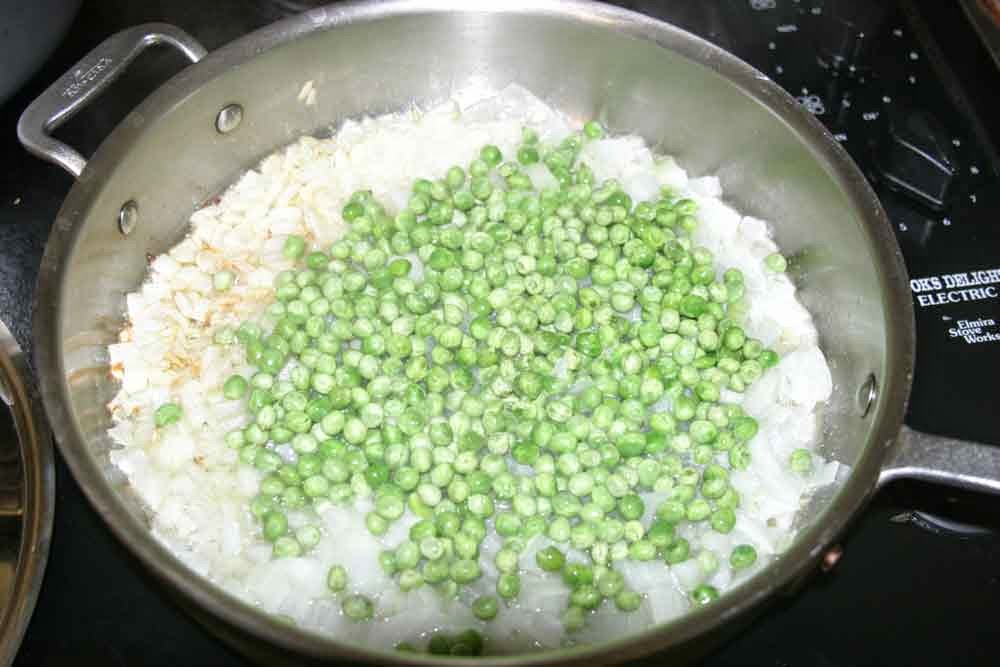
When the onions are somewhat clear, add the frozen peas and let warm through.


Add the prosciutto and let cook for a few minutes. 


At this point, add your fettuccini noodles to the boiling water.  


Boil until they are al dente. 

Add heavy cream to the skillet 


and allow this to simmer for a few minutes or until the sauce has thickened to your liking. 
Salt and pepper the sauce to taste.  Add a little fresh thyme if you have it. 

When the noodles are ready


Add them to the sauce 


and stir until noodles are well-coated. 


Serve immediately with some freshly grated parmesan. 


Until Next Time,

Ciao!


Chris


Saturday, May 31, 2014

Alfredo Sauce


I first discovered Alfredo sauce back when Fettuccini Alfredo was all the rage back in the eighties.  I loved it then, and I love it now, so we make it at home from time to time. 

Now, this sauce ain’t exactly what you’d call light, but hey, you’re not gonna eat it every day, right!  Every once in a while with this rich, decadent sauce and you’ll be fine.  Goes great with Fettuccini, Rigatoni, and several other pastas.    


Alfredo Sauce

1/2 cup butter
2/3 cup heavy cream
1 1/4 cup grated Parmesan cheese
1/4 teaspoon salt
dash of pepper

Heat butter in saucepan until melted.  


Add cream 


and allow to heat through, stirring frequently.  Remove from heat.  Add Parmesan cheese, salt and pepper.  Stir until sauce is blended and fairly smooth.


Yes, it’s just that simple.  And some things in life should be, right?

Here we’ve served it with some nice Campanelle pasta.


Until next time,


Chris

Wednesday, May 14, 2014

Smoked Bison Brisket


Ingredients

1 Bison Brisket
8 oz marinade (Gold Buckle Brand)
2 oz Paprika
2 oz Granulated Garlic
2 oz Chili Powder (optional)


So if you know me very well at all you know that brisket has been one of my signature dishes for a long while.  Beef brisket.  Beef from a cow.  Well, a while back my wife (from Colorado) introduced me to bison meat.  Some folks call it buffalo, and that’s cool, but technically it’s bison in North America.  Anyway, we had bison burgers and a little later, bison rib-eye steaks.  Both were delicious.  Lean and very beefy flavored. 

So, I was at Central Market a while back, and I saw they had bison brisket for sale.  I just had to try it. 

The first thing that surprised me about the bison brisket was that it was rather small, just a couple of pounds.


But it looked like a complete piece of the flat (of a cow’s brisket) so I didn’t think that they had trimmed or halved it.  Perhaps the brisket muscle is just smaller on a bison, even though they are a bit of a larger animal than a cow.  (or maybe they harvest the meat from smaller ones.  Anyone know?)

I did some research, and what I found confirmed my suspicions.  Bison is very lean meat, and this includes the brisket as well.  Apparently it still has some tough connective tissue (collagen) like a cow’s brisket, just not as much.  The lesson here is I was going to have to use a much shorter cooking time to keep from drying out and overcooking this beautiful little piece of meat. 

I started out treating it like my normal brisket recipe, giving it a nice rub of paprika and granulated garlic, then marinating it in Gold Buckle brisket marinade overnight.  


When it came time to cook, I fired up my Weber kettle in smoker configuration, just half a chimney of charcoal and some hickory chunks.  


I got it settled in at about 225F, and I smoked the brisket for two hours. 


At this point, the meat was at about 160F internal temp, and I didn’t want to leave it on the smoker any longer for fear of it drying out.  But, it still felt a bit tough, so I knew there was still some collagen left to break down.  Solution:  I transferred the meat to the oven.

First, I boiled the reserved marinade liquid, then added it to the brisket in a casserole dish, hoping this would help keep the meat from drying out, as well as add additional flavor.  


I set up a very slow oven, 180F, and roasted the brisket (covered in foil) for an additional two hours.  At this point I removed it from the pan and let it rest for fifteen minutes. 

Then I sliced it up.  


The collagen had broken down beautifully, and the brisket sliced like butter, similar to one of my beef briskets that would have cooked for 18 hours or longer.  All this in only four hours. 

We served it with some roasted red potatoes and Cowboy Beans, and it was a hit.  


The brisket was every bit as flavorful as my traditional Texas-style brisket, and it a quarter or so of the time.  The only down side was the cost.  Bison meat can be quite expensive.  I paid over twenty bucks for this two pounds of meat, about the same as a 15 pound beef brisket when you catch it on sale. 

So, final verdict.  The taste is about the same as beef, so if you’re pressed for time, and money is no object (and if you can find it) then bison may be the way to go.  For me, I’ll probably stick with my beef recipe most of the time, and do the bison now and then for a change of pace. 

Until next time,

Don’t be buffaloed, try some bison!


Chris

Wednesday, April 30, 2014

Dutch Croquettes


A couple years ago the wife and I visited Holland, a very charming country with charming people and charming food and drink.  As you might expect, we spent a lot of time in charming little pubs drinking some of their charming beer and wine.  We also dined at such establishments quite often, and one thing that was always on the menu was meat croquettes. 


I wasn’t quite sure what to make of these tubular little fried cylinders of meat the first time I saw them, but I found I had to try them, and I definitely liked what I tasted.  Man, these babies were great.  Succulent and savory inside and crispy and crunchy on the outsize.  They made for a great lunch.  They were usually served with bread so they could be crushed up and eaten like a sandwich, but I just ate 'em straight up.

Well, come to find out, these things are one of the most popular food items in Holland.  They are so popular that all the McDonalds in The Netherlands serve their own version called a McKrocket. 


(yes, we tried these too, and they were delish.  Please don’t tell anyone we ate at a McDonalds, though.  (All in the name of food research, of course.))

While we were there, my wife bought me a Dutch cookbook to add to my cookbook collection, and when we got home I was delighted to find it had a recipe for Croquettes.  I whipped up a batch, and they were pretty good, I must say.  Good enough for the old Eat’n Man blog, so, without further ado, here ya go:


Dutch Croquettes

1 lb Lean Stewing Beef or Veal Shoulder, Cubed
3 Tablespoons Butter
1 Onion, Cut into Wedges
2 Carrots, Cut into Pieces
Couple Springs Parsley and Thyme
1 Bay Leaf
1 Mace Blade or 1/2 Teaspoon Ground Mace
Several Black Peppercorns
3-4 Cups Beef Broth
1/4 Cup All Purpose Flour
1 Egg Yolk
1 Teaspoon Finely-Chopped Parsley
A Few Drops Lemon Juice
Vegetable or Peanut Oil for Deep Frying

For The Breading

2 Cups Seasoned Bread Crumbs
2 Eggs
2 Teaspoons Olive Oil

Cut your meat into cubes and season with a little salt.  The traditional meat for Dutch Croquettes is veal, but this is a bit expensive over here, so I tried it with round steak and things came out just fine.  Use whatever stewing beef you like, or if you want to be uber authentic, go with some veal. 


Sauté the meat cubes in the butter for about five minutes or so, until nicely browned.  Add the Onion, Carrots, Parsley, Thyme, Bay Leaf, Peppercorns. 


return the beef to the pot... 


...and enough beef broth to cover.  


(note, the original recipe called for simply using water instead of beef broth.  This would of course work out fine if you want to do it, but I went for the broth for a bit more ‘beefy’ flavor)  Bring to a boil, then reduce heat and simmer for 2 hours or so, until the beef is tender and completely cooked. 

Remove the beef with a slotted spoon and mince it finely in a food processor.  


.


Strain the cooking liquid from your pot and reserve 1 cup of it. 

Melt more butter in a skillet and then sift in the flour and allow it to cook for a couple minutes.  


Stir in the reserved cooking stock.  Cook until thickened. 


 .

Add the egg yolk and stir vigorously.  


Remove from heat.  Stir in the minced beef or veal, 


then the parsley and lemon juice.  Stir everything up well until the meat and sauce are thoroughly mixed.


Spread the mixture on a large platter or baking sheet and cool it in the fridge for a couple hours. 


Divide the mixture into eight portions.  Shape these into cylinders by rolling and patting them on a cutting board. 


 .

Beat the two eggs with the olive oil and place in a shallow bowl.  Place the bread crumbs in another.  Roll each croquette in breadcrumbs, then the egg mixture, then in the breadcrumbs again.  


Place on a tray and chill until you are ready to cook. 

Heat the vegetable oil to 350F 


...and fry the croquettes for 5-6 minutes, 


...until they turn chestnut brown.  


Drain them on a paper towel, then serve immediately with some spicy mustard and a side of fries (or frites, as they call 'em in Holland)


 .


Until next time,

Hope you enjoy these ‘Dutch’ Treats.


Chris