Wednesday, February 16, 2011
Flashback to Tuscany - Steaks on the Fire
(This is the second in a series on cooking in Tuscany. Part 1 here)
When we visited Tuscany in ‘09, our villa had this wonderful open hearth fireplace.
As it was cold most nights, we put it to good use. As I sipped wine beside it the first night, I couldn’t help but ponder that it had probably been used for cooking in centuries past. And that got me to thinking, why not try to cook something with it?
The answer, of course, was steaks. We hit the market the next day, and I selected a couple different cuts to attempt to cook over the open flame of the fireplace. I got two good sized filet mignons, as well as some thin cuts from the rib section (what I would call 'entrecote' if I were in France).
Now, how to cook the steaks? Luckily, there was a large iron skewer next to the fireplace. It was probably meant more to be a poker, but I cleaned it up and rubbed it with a little olive oil, and the steaks slid on it no problem.
I initially held the steaks over the fire, trying to get a good sear, but it was not to be. The steaks weren’t searing, but the skewer was becoming too hot to hold. So, I went to plan ‘B.’ There was something resembling a rack in front of the fire, so I laid the skewer across this, and went back periodically and turned the meat.
The steaks eventually cooked, but it was slow going. Since they sat more in front of the fire than above it, there was no high heat cooking going on, but more of a slow roasting. The cuts I selected would have benefitted more from the intense heat of a charcoal fire, and I found that they were so lean they dried out a little. If I cooked with an open fireplace fire like this again, I would get a tougher, more roast-like cut like an eye of round, which would benefit more from slow cooking.
So, a few days later the wife and I were wandering through the San Lorenzo Market in Florence, and I spotted this amazing hunk of beef.
Yes, that’s an entire primal cut from which T-bones and porterhouses are cut. My mouth was practically drooling as I told the butcher in broken Italian to cut me a two inch thick porterhouse. He hacked away with a cleaver, and this is what we had when we got home.
I knew I had to grill this one up proper, so I asked the lady next door if she knew where I could get a grill. She said she had one, and would be glad to loan it to us. Well, it turned out to be the worlds smallest grill, measuring just big enough to fit that massive porterhouse on top. But, it did the trick.
The fireplace helped out as well. I used some burning embers from it to start the little bag of charcoal which we’d also found in the market.
This time, we got a perfect steak for our efforts. Mama Mia was it good! And big enough to serve two!
So, until we meet again, I'll leave you with a last image, from that same night: Twilight gathering over the city of Florence in the distance. Makes me wish I were there once again, drinking wine, and cooking something delicious!
Until next time,
arrivederci,
Chris
Sunday, January 30, 2011
Coq Au Vin
Chicken stewed in rich red wine. Mmmm, the French certainly know how to live...and how to eat. This is one of my favorite dishes from the Auvergne/Bourgogne region of France, though these days you can find it all over. Of course, it's frightfully easy to make yourself, you just need to allow enough time for the chicken to slow cook in the burgundy wine until it's almost fall-off-the-bone tender and full of flavor. I usually start several hours before my planned dinner time.
I also start with a whole chicken. While you can buy your chicken already cut up, I like to use a whole bird, as you get more bang for your buck, and you also get things like the neck and back bones, and more bones in the stew mean more flavor in your sauce. (You can discard the bones after you're done) I also enjoy cutting up the bird--it's a good skill to keep up in your kitchen repertoire. I also encourage using the whole bird because you get a pretty much equal amount of light and dark pieces, and your sauce won't be as rich without the dark meat. If you've got a lot of white meat eaters in the house, buy a couple extra breasts and make a slightly larger batch of Coq Au Vin.
Coq Au Vin - A French Chicken Casserole
1 Chicken, cut into 10 serving pieces
6 Tablespoons all purpose flour
1 Bouquet Garni (Bay Leaves, Thyme, Parsley, Rosemary)
2 Slices of thick bacon
1 Tablespoon olive of vegetable oil
2 Tablespoons butter
24 small mushrooms
24 pickling onions, peeled
1 bottle red burgundy wine
3 cloves garlic, peeled
Cut the chicken into 10 pieces: Two breasts, two thighs, two drumsticks, two drumettes, and two flappers. I use a cleaver to chop up the bird, so I never seem to be accurate enough to split the spine, so this usually comes out as a 'bonus' 11th piece. There's no meat on this 'backbone' piece, but it's a good piece for stewing, so I add it to the pot, and discard it later. Here's what I've got when I'm done:
Season the chicken pieces with salt and pepper, then dredge in the flour. Set them aside for now.
Next, cut your bacon rashers (did you know pieces of bacon were called rashers?) into matchsticks, as in the picture below.
Saute the bacon matchsticks in a large pot until they become crispy. Remove and set aside. Add the oil and butter to the pot and saute the onions and mushrooms until golden brown. (regarding those little onions...they can be tough to peel. A trick to make things easier. Drop them in boiling water for a minute or two, then strain. Their peels will slip right off. Dry them well before you saute)
Remove the onions and mushrooms and add to the bacon. Set this aside for now. At this time you can start browning your chicken pieces, two or three at a time, until they all have a nice sear. At this point, many Coq Au Vin recipes will tell you to add all the pieces to the pot, pour cognac over them, and ignite. I used to do this, as it was cool to see that pretty blue open flame in the pot, but I've since made the dish several times without this step, and have noticed no difference in flavor. I now consider it a waste of good cognac. Or even bad cognac. So just skip this step and save the courvoisier for the ladies man.
Add the chicken pieces to the pot, and add the wine. You don't need a top notch burgundy for this, really any good red table wine will do. I use a wine called L’Epayrié, which you can find in most grocery or liquor stores. I buy a 1.5 litre, so I can make sure to have enough to just cover the chicken in the pot, and still have enough left over for a few glasses for the chef.
Bring the wine to a boil, then reduce to a simmer. At this point, add the bouquet garni, and salt and pepper to taste. Some people also add a little nutmeg and sugar at this point, but I find I like it better without. Oh, what's a bouquet garni, you ask? This is a little bundle of herbs you will encounter often in French cooking.
A bouquet garni is simply bay leaves, parsley, thyme and rosemary tied together with cooking twine into a little bundle, as shown below.
Add it to the pot, and let it simmer away for an hour or two. The longer, the better, in my opinion. But make sure you keep the pot on a gentle simmer--you don't want to boil away the wine. Thirty minutes before you are ready to serve, add the mushroom/onion/bacon mixture back in and simmer for, you guessed it, thirty minutes.
To serve, remove the chicken pieces from the pot and arrange on a serving platter. Remove the bouquet garni and discard. I also use a skimmer and remove the mushrooms and onions and place on the platter as well. Now, turn up the heat and boil the remaining liquid until it reduces to a thick sauce, which should happen in a few minutes. If it doesn't seem to be thickening for you, add a little mixture of corn starch and water, a few drops at a time, until the sauce thickens.
Serve the sauce in a carafe or small pitcher so your guests can pour it over the chicken. The dish goes lovely with a side of roast potatoes.
Enjoy, and until next time, Bon Appetit!
Tuesday, November 23, 2010
Spiced Autumn Soup
I came across this recipe in an old cookbook, and was enchanted by the name. I love all things Autumn, from the blazing, colorful foliage to the early chill in the air; from the scent of chimneys firing up for the first time to the bountiful harvest of fruits and vegetables that are available fresh from the farmer’s market.
This soup makes good use of those fruits and veggies. We tried it a several years back, and have now made it just about every year to celebrate the season.
Spiced Autumn Soup
4 Tablespoons Butter
2 Large Onions, Coarsely Chopped
2 Potatoes, Coarsely Chopped
2 Carrots, Coarsely Chopped
3 Cloves Garlic, Crushed
Zest and Juice of 1 Orange
2 teaspoons mild Curry Powder
7 ½ Cups (1.8 liters) Chicken Stock
26 oz. Canned Chopped Tomatoes
2 Apples, Peeled and Chopped
1 Tablespoon dried Basil
Salt and Black Pepper
Melt the butter in a large saucepan, and add the onions, and cook for a few minutes, until they begin to turn clear. Add the potatoes, carrots, garlic and zest, and cook gently, stirring occasionally, for about 5-10 minutes.
Zesting an Orange: If you're like me, and have been to too many Pampered Chef parties, you probably have this citrus zester:
It makes short work of zesting an orange peel:
If you don't have this fancy little gadget, you can just use a peeler and then dice the zest with a kitchen knife. If you have a particularly large orange on your hands, you might only use half the zest...it is pretty pungent.
Next, add the curry powder and cook, stirring, for 1-2 minutes more. Then add the stock, orange juice, tomatoes, apples, basil, and salt and pepper to taste. Bring to a boil, cover, and simmer for 30 minutes or until the vegetables are tender.
Puree the soup in a food processor or blender until smooth.
Return to the pan, reheat, and taste for seasoning.
Serve at once, preferably with some crusty, fresh baked bread or herb croutes.
(coming soon in a future blog post: Rustic French bread!)
Hope you like the soup. Until next time, Happy Autumning!
Chris
Wednesday, October 27, 2010
Coal Roasted Corn on the Cob

Just got back from a trip to Maryland, where our friends at Richardson Farms grow some of the best sweet corn I’ve ever tasted. And there's just about nothing I love more than corn fresh out of the field.
(The Eat'n Man gets his corn fresh from the field)
(Fresh picked ears, ready to roast)
Fresh from the field is really best that way, because as soon as you pick an ear, the sugars begin to morph into starches, taking away the sweetness. We brought a suitcase full home from Maryland with us, and after chowing down on several ears, I decided I would blog on my unorthodox method for roasting corn.
Of all the different ways to cook corn, I think coal roasting is the best, as it generates an amazing, sweet, earthy aroma as the corn roasts, and the flavor is out of this world, as some of the sugars in the corn will slightly caramelize from the intense heat. You can roast corn in your oven, or on a gas grill, but I find that nothing beats roasting it directly on top of hot, burning charcoal.
This is really one of the simplest methods of cooking anything, similar to hobo pack cooking, where you wrap food in foil and place it directly in the hot coals of the fire. First, simply take the corn, unhusked, and wrap each ear in a layer of foil. You might snip the tassel and long leaves off the top, but otherwise you don’t need to do much to it.
The foil will protect the husks from burning, and the corn will be steamed and roasted inside its own husk. There’s a lot of flavor and aroma in the husk, and particularly the corn silk, that will be released with this method--so don't be tempted to remove either before you wrap with the foil.
Place the corn directly on the hot coals. Let it sit about five minutes, then, using long tongs, give each ear about a third of a turn. Let that go another five minutes, and then one more third turn. Five minutes later, you’re done. Pull the corn from the fire and let it rest a few minutes, so the husk will cool.
When you remove the foil, you’ll see that the husks are slightly scorched, but the corn inside will be perfect.
With a little butter and salt, you’ll have a great side dish for a variety of entrees. Here we’ve served it with some sliced Flat Iron steak.
Until next time,
Stay Corny,
Chris
Tuesday, September 28, 2010
Green Chile Stew
One of my favorite parts of mid September is that it’s Hatch chile season. That’s when the tasty, spicy, pungent green chiles flow from Hatch, New Mexico to a market near you. They are to green chiles what Dom Perigon is to Champagne. They make the best green chile sauce, green chile enchiladas, or as we’ll see here today, green chile stew.
You can buy the Hatch Chiles already roasted and peeled at places like Central Market or Whole Foods, but it’s a lot cheaper to buy the fresh and roast them yourself, and it’s a lot of fun too. Plus, the aroma alone of the roasting peppers that floods your back yard is worth the effort.
Green Chile Stew
8 New Mexican Green Chiles, roasted, peeled, stems and seeds removed, chopped
2 pounds lean pork, cut in to one inch cubes
2 tablespoons vegetable oil
2 large onions, chopped
4 cloves garlic, chopped
1 large potato, peeled and chopped into ½ inch cubes
2 cans beef broth
3 cans chicken broth
1 can water
1 teaspoon cumin
½ teaspoon salt
½ teaspoon white pepper
2 tablespoons fresh cilantro, chopped
1 jalapeno, diced
Dash Mexican oregano
To roast the chiles:
Prepare a medium hot charcoal fire. Place the chiles on grate over fire, and allow the skin to blacken and blister.
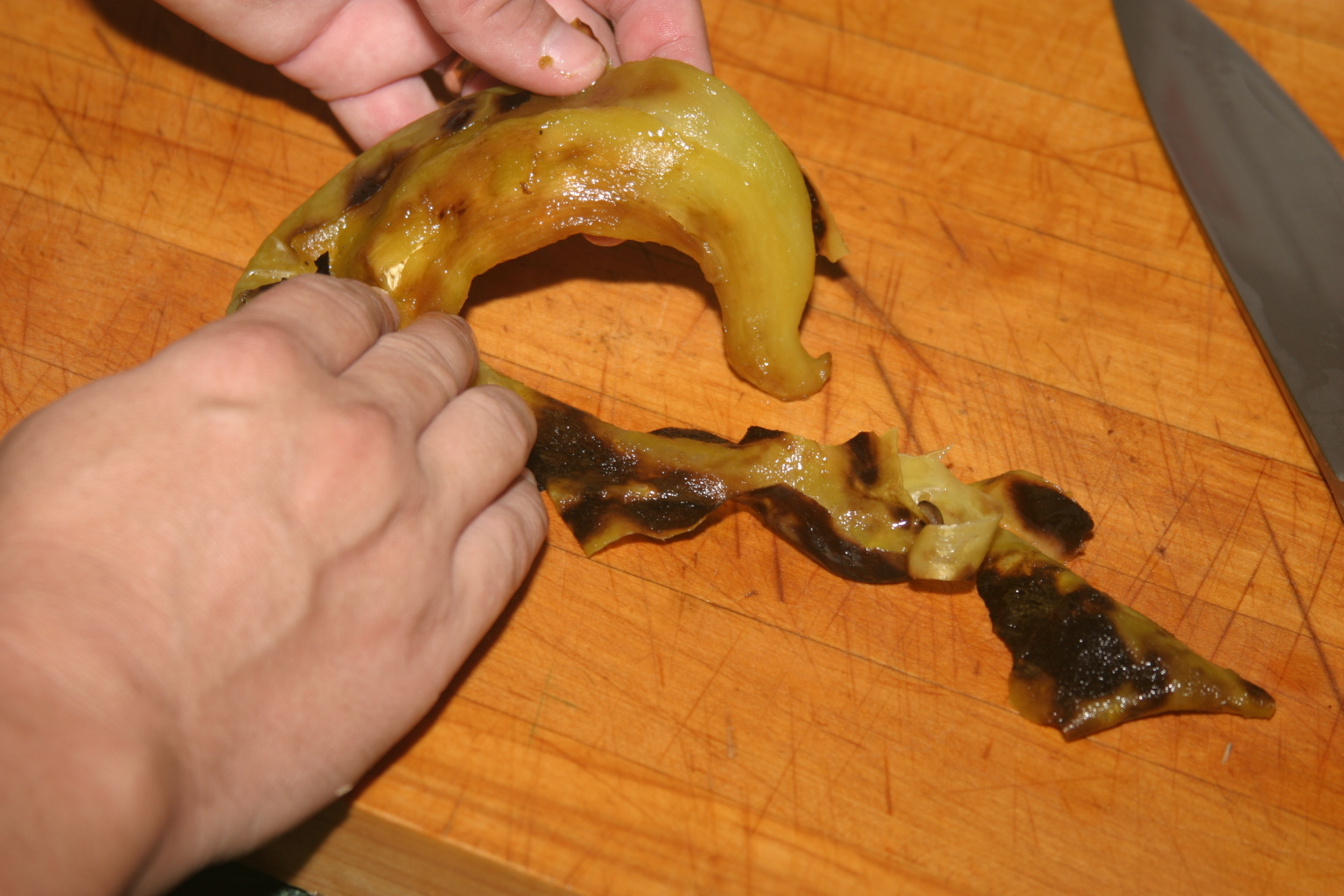
Turn chiles so that all sides are exposed to the fire. Remove from fire and place chiles in a freezer sized ziplock bag for 10-15 minutes. This will allow them to sweat, and the skin will slip right off.
After 15 minutes in the bag, note how easily the skin peels off:
Cut the stem end off the chile and squeeze out the seeds, then coarsely chop the chiles.
Meanwhile, brown the pork in the oil, remove and drain.
Add the onion and garlic to the oil and saute until soft.
Next, place all the ingredients in a soup pot and simmer for two or more hours. Chop a little extra fresh cilantro to garnish the soup when you serve. Voila, Green Chile stew!
Note: In researching recipes for Green Chile Stew, I came across several that included tomatoes. I’ve tried it this way, and it does make a very flavorful stew, but I noted in my research that their use was controversial in some circles, and most New Mexican purists avoided tomatoes. Since I’m no stranger to ingredient controversies, i.e., beans/no beans in Texas chili (I’m firmly in the ‘no beans’ camp, but that’s for another article) I decided to leave out the tomatoes. Its keeps the stew greener anyway.
Viva los chiles,
Chris.
Friday, September 10, 2010
Flat Iron Steak
Yes, I’ll freely admit it, I’m a carnivore. I love love love me a good steak: Tender, juicy and rare. But when I’m not chowing down on tenderloins or rib-eyes, I like to try some of the other cuts out there. This is one that’s been an up and comer in the beef world in the past ten years – the Flat Iron steak.
This is one of the newer cuts of steak ‘discovered’ in the past couple of decades. It comes from the chuck, or beef shoulder, which as a whole is tough and fatty and not what you’d call prime beef. But hidden in the chuck is this one little sliver of a muscle that is as full of beef flavor as a round steak, but tender as a filet. Except for a few savvy meat cutters, this steak went unnoticed for centuries, which is why is it sometimes referred to as the ‘butcher’s steak.’
Nowadays, however, it’s been rescued from the hamburger grinder and is available at most grocery stores and meat markets, and while the price is going up as it gains fame, it’s still somewhat affordable compared to the prime cuts.
The Flat Iron steak works great on the grill, and is flavorful enough to need no adornment, but I usually marinate with a little Allegro just to indulge myself.
After that, grill it like any other tender cut of meat. A hot charcoal fire, as hot as you can get it...to sear the outside...
...and leave the inside juicy and pink.
Slicing it thin, against the grain, will enhance the tenderness, and make a nice presentation.
Ah, it’s like heaven on a plate. Here served with some roasted corn on the cob.
Until next time,
Grill ‘em if you got ‘em.
Chris
Tuesday, August 31, 2010
Green Beans a la Bubba
O people of the blog-O-sphere, August was quite busy, and I find myself with only four measly blog entries for month. It’s the 31st, and I thought I better try to squeeze at least one more in before the calendar flips over to September. All this busy-ness brings to mind that sometimes is good to have a few simple side dishes in your culinary tool kit for those occasions when you’re pressed for time in the kitchen.
Here’s one I learned from my friend Bubba. It’s almost so simple you’d be hard pressed to call it cooking, as the main ingredient comes from a can. But I find it very tasty, and the ingredients can all be kept on hand in your pantry for months at a time. So when you’ve slaved away on a fancy Châteaubriand or some other culinary delicacy, and you need a little something to complement it on the side, you can pull this one out of your hat. You can even call it something fancier if you fancy that...Bubba won’t be offended.
Green Beans a’la Bubba
1 Can French or Italian Cut Green Beans
1 Packet Goya Ham Flavored Concentrate
2 tablespoons Diced Dried Onion
Open can of beans and do not drain. Add to a sauce pan over medium heat. Add the packet of ham flavoring and stir. Add the onions and do the same. Turn heat down to low and let the onions steep until they re-hydrate a bit. Voila, you’re ready to serve.
Well, that’s it for this time.
I’ll see if I can’t come up with something a little more elaborate and along the lines of ‘real cooking’ for next time.
Until then,
Y’all take care,
Chris
Subscribe to:
Posts (Atom)