Showing posts with label poultry. Show all posts

Sunday, December 20, 2015

Holiday Roast Goose


Several years back the family and I did a themed Christmas--Dickens themed to be exact.  This mainly involved costumes, but some of it translated to the food as well.  We had (in addition to the Turkey) a standing rib roast and some sort of figgy pudding.  What we didn't have, though, was the quintessential centerpiece for any Victorian-themed table:  A Roast Goose.

Reason--Well, I couldn't find one, but I have to admit, back then, I didn't look that hard.  I was a little bit intimidated by roasting a goose for the first time, and perhaps a bit worried how the family would take to it.

Well, I was at the grocery the other day and I saw frozen geese for sale, and the wheels in my brain started turning.  Should I finally try this for Christmas?  Well, it was a few weeks before, so I decided this was the perfect time to to a test roast on a goose--see if I could pull it off and see how it tasted.

Here's the goose I found at the store:


I'd seen this brand once at Central Market selling for around $75 bucks for an eight to nine pound bird.  This one (same brand) was selling for $35 at my local groc, so I figured it was time to snatch one up.

Out of the plastic and thawed it looked like this.


Much longer and thinner than a fat American turkey.  Also, check out these wings:


Unlike the stubby wings of a common turkey, the goose is a true flier, so it's got some incredible wings.  They were so long, in fact, that I trimmed them up a bit (saving the cut pieces for stock)

Now, how to roast this sucker?   I've roasted quite a few turkeys over the last 20 years or so, and despite the fact that many people find such a thing intimidating, it couldn't be any easier.  Roasting a turkey is just a matter of time and temperature.  Roast it in the oven until it reaches the right temp--just don't overcook it.  Turkey comes out perfect with the breast 165˚F and the legs about 180˚F.

In researching goose roasting techniques, I found recommendations all across the board as to final temp.  Martha Stewart said to roast until the breast was 180˚F.  I cringed a little at this, as even I with my limited goose roasting knowledge knew that such would dry out that breast.

The FDA says to cook goose to 165˚F.  That's fine with nice white meat turkey, but with the dark red meat of goose?  Finally Hank Shaw, author of the cookbook Duck, Duck, Goose, recommended the rather unorthodox technique of cooking the breasts to 135˚F, then removing them, and then cooking the rest of the bird to 180˚F.  This sounded intriguing, as several other recipes said 135˚F was fine for the breast.  But, I really wanted a whole bird as the final product, as it makes such a purdy presentation.

I finally decided to roast to 150˚F in the breast, and see where I got with the thighs and other dark meat.

To prep, first I used a sharp boning knife to cut several slits in the skin of the breast, drum and thighs.


This bird is going to render a lot of fat, so you've got to give it a way to leak out.  By the by, just as with my entry on duck breast, don't throw out that fat, it is one of the most luxurious fats there is, great for roasting or flavoring other dishes.

After this, I squeezed some lemon juice on the skin,


then rubbed it in with the lemon.
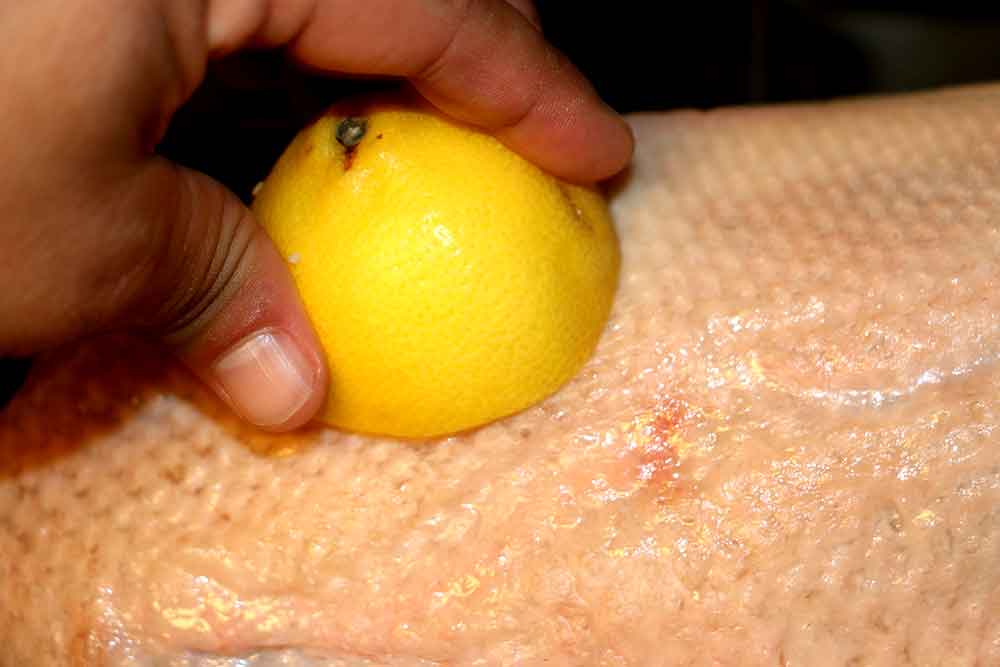


Then I deposited the squeezed lemons into the bird's cavity,


Along with some fresh rosemary from the garden.


Then it's into the oven at 325˚F.


Yes, this is a rather low temp, but as Hank Shaw suggests, the bird needs time to render that fat out.

I ended up roasting for about an hour and forty-five minutes to get to 150˚F in the breast.  The thigh at this point was about 165F, so it was acceptable.

Here's the final product.


Take a gander at that goose!

The breasts are a little thin for carving like a traditional turkey, so I removed them and sliced them crosswise instead, as you can see below.


Final verdict:  The bird was good, but the decision I made to get a 'whole bird' presentation compromised things a bit.  The breast was tasty, but a bit dry.  Next time I will try the 'remove the breasts at 135˚F' technique.  I think, like my duck recipe, they will be much better that way.  This is a red meat bird, like duck, and I think it is best on the rare side.  As for the thigh meat, it was still a little oily--it could have benefited from a longer cooking time.  Shaw says if you take the thighs to 180˚F, you'll get almost a confit-like, falling apart consistency, which is intriguing, as I like duck confit, so I may just do everything separate next time.

Anyway, it was a worthy experiment.  Oh, and that fat.  I roasted some potatoes in it.  Best I've ever tasted.

Until next time,


Hope you get a goose out of this recipe!


Chris


Sunday, November 15, 2015

Smoked Turkey Breast


If you read the blog regular-like, you'll remember we covered smoking a whole turkey a couple years back, and it came out great.  I now do one every year--come Thanksgiving and Christmas (and sometimes, a few other times as well)--in addition to my roasted and my fried turkeys.  Yes, we like our turkeys here at An Eat'n Man, but we also like turkey leftovers, and with the size of the Eat'n Man's extended family, one turkey just won't cut it.

Now, at the other end of the spectrum, what if you just don't need that much turkey, or just don't care for the dark meat.  Well, perhaps this is your answer--a single turkey breast.  Just enough for a meal for say four to six, with maybe a smidge left over for a sandwich the next day.  The folks at Butterball hawk a nice pre-cut, pre-packaged turkey breast that is basically ready to go in the smoker.


Looks like this when you get it out of the bag.


Note, it'll be a little smaller than you thought it was--they usually include a bag of gravy mix inside there with the breast, so your eyes will deceive you from when you first heft the package.

Anyway, fire up your smoker with a nice light wood like apple or peach--poultry meat readily absorbs smoke flavor, which is good, but this means more pungent woods like hickory and definitely mesquite are out.  Set your temperature to 300-325˚F.

Oh, before we begin smoking, you might want to remove the stretchy webbing that surrounds the breast.


I didn't, and I found it sort of cooked into the turkey meat, and was a bitch to remove.  The only problem is, if you do remove it, the breast may sort of droop or fall apart.  Solution:  Take it off and then tie the breast up with a few loops of kitchen twine.  Problem solved.

Smoke for 30 minutes.  Breast should now look like this.


Rotate breast around 180˚ and smoke for another 30 minutes.  Check the temp with a meat thermometer in the thickest part of the breast.  It should be getting close now.  Continue smoking until the internal temp hits 160˚F.


Take out and let rest in a warm spot in your kitchen.  Internal temp will continue to climb to 165˚F, which is just right for turkey breast.

Slice and serve--it's just that easy.


Until next time--no reason to go cold turkey with this recipe!

Chris


Sunday, April 12, 2015

Duck Breast in Red Wine Sauce


Ah, Duck.  While it's one of the great delicacies of the culinary world, Duck is one dish in which many Americans never partake.  This is a shame, because Duck is rich, savory, succulent and full of flavor; it's surprisingly meaty, almost like a beefsteak, and it holds up well to fancy, full-flavored sauces like this red wine sauce presented here.

Duck should be on your culinary agenda to try--and not just at that fancy French restaurant that you've been meaning to try.  Duck is quite easy to prepare at home, and--though not foolproof, it can be quite simple.  This dish here is about as simple as it gets, but your guests will think you slaved away at this one with as much rich flavor as it ha.  And the thing is, even though we are saucing it up, most of the flavor comes from the duck meat itself.

Duck Breast in Red Wine Sauce

1 10-12 Oz Duck Breast
2/3 Cup Beef Stock
2/3 Cup Red Wine
1 Tablespoon Tomato Paste
1 Teaspoon Lemon Juice
2 Tablespoons Butter
Dash Herbs de Province
Salt and Black Pepper to Taste

First, get a hold of a good duck breast.  Round here, this isn't something you can usually find in your run of the mill grocery store.  We found what we were looking for at Central Market, where we opted to spend a little extra to go with a Muscovy Duck Breast, rather than run-of-the-mill Mallard.


Since it was just the two of us, one breast (at almost a pound) was plenty to split.  If you've got more mouths to feed, just multiply the ingredients above as needed.


To begin, score the skin side of the breast with a sharp knife


in a crosshatched pattern.


This will help the breast cook evenly and allow it to release its precious fat.  Whatever you do, don't ever remove the skin--its perhaps the best part--it crisps up nicely and also has a great deal of the duck fat that we'll be using later.

Sauté the duck breast skin side down 


over medium-high heat in a skillet for around ten minutes.  This is one of the few cases when you won't have to add any oil or fat to the pan first--the breast will release its own as you sauté.  


After a few minutes, the breast begins to release its fat

This duck fat is like gold, or maybe even platinum.  It is rich, decadent and flavorful.  If you have never had French fries fried in duck fat then you are truly missing out.  Always save the duck fat when you cook a dish like this.  You can freeze it and keep it for several months, or better still, use it to make a side dish for your duck breast.  Vegetables or mushrooms sautéd in duck fat are fabulous; you could also toss some potato chunks in the fat and then roast them, or even scramble your eggs the following morning in a little bit of it.  Today, we'll be reserving some for our sauce.  


Reserved Duck Fat  -- Pure Gold, Baby!

After the skin side of the breast crisps up, flip it and cook on the other side for another five minutes or so.  


Of course take a moment and admire that beautifully crisped skin.


Using a meat thermometer, check the temp of the breast at its thickest part.  Duck is poultry, so the USDA is gonna tell you to cook it to 160F, but this will dry it out and toughen it.  Duck, however, is also a red meat, and thus you can get away with medium rare, which is what we prefer, around 135 F on the thermometer.  Pull the breast when it is this temp 


and keep warm.  


Remove all but about two tablespoons of the duck fat from the skillet.  (reserve that fat!)  Add the beef stock to the skillet.  


Add the red wine.  


Add the tomato paste.  


Stir to combine.  Add the lemon juice


Add the butter.  Stir until melted.  


Add the herbs and then salt and pepper to taste.  Cook until sauce thickens a bit.  

Slice the breast crosswise 


from one end to the other.  


Serve immediately with the sauce.  


Until next time, 


Chris